All about collagen for athletes

Collagen is one of the most talked-about supplements right now. From athletes to beauty vloggers, collagen seems to be everywhere. Collagen supplements may not be new to you, but have you heard of collagen smoothies, gummies, skincare, coffee, tea and even beer? But what exactly is collagen, and how can you use it as an athlete? We explain it here.
What is collagen?
Collagen is a protein that occurs naturally in the body, including in bones, cartilage, blood vessels and skin. Outside the world of sport, collagen also receives a lot of attention. You will often find it in beauty products. Collagen may help maintain an elastic, firm and hydrated skin. In this article, we focus on the use of collagen for athletes.
Collagen differs from whey and casein protein supplements. Whey and casein are known for being rich in essential amino acids, while collagen has a different profile. It contains relatively high amounts of the amino acids proline, glycine and hydroxyproline, which sets it apart from other proteins.
Collagen for athletes
More and more athletes are choosing to add a collagen supplement to their daily routine, from professionals to recreational athletes. One of these athletes is handball player Kay Smits.
“During handball, my body is put to the test with all the jumping, turning and physical contact. Collageen Gold contains vitamin C, which contributes to the maintenance of strong bones. For me, it’s a great daily addition.”
Kay Smits
Handball player
Collagen in food
Collagen is only found in animal products. Just like in humans, the connective tissues of animals contain collagen, mainly in the skin, bones and cartilage. Foods that naturally contain collagen include bone broth and fish eaten with the bones. Gelatine also contains collagen, as it is produced by partially hydrolysing collagen from the skin and bones of mammals.
Taking a collagen supplement
As part of a healthy, varied diet, you may choose to take a collagen supplement. One advantage of a supplement is that you know exactly how much collagen it contains, whereas the amount in foods can vary (1).
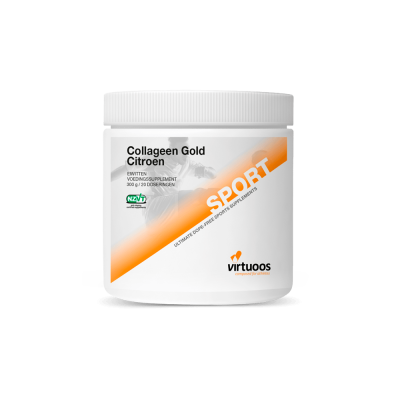
Collageen Gold comes in a convenient powder form, making it easy to mix with water. Collagen supplements are often combined with vitamin C (2). This vitamin contributes to normal collagen formation for the normal function of cartilage and for supporting bones (3). Each serving of Collageen Gold contains 80 mg of vitamin C.
How to use Collageen Gold
Take 15 grams (two scoops) of Collagen Gold around 45 minutes before training. Mix the powder with water or fruit juice, or add it to a tasty smoothie (see the recipe below).
About Collageen Gold
Collagen Gold delivers 15 grams of high-quality bovine collagen peptides from ProTakeTM BH and 80 mg of vitamin C per serving. Vitamin C supports the formation of collagen, which is important for bones. Every batch is NZVT-certified, giving athletes the assurance that it has been tested for the absence of doping-related substances.
Collagen smoothie recipe
A smoothie is, in our opinion, one of the most delicious ways to enjoy collagen. This tropical mango–orange smoothie combines carbohydrates, fluids, vitamin C and collagen in one glass. Refreshing, fruity and ready in no time.
Ingredients:
- ½ mango
- 300 ml orange juice
- 15 g Collagen Gold
Preparation:
Place all the ingredients in a blender, blend until smooth, pour into a glass and enjoy immediately.
Sources
- Alcock, R. D., Shaw, G. C., & Burke, L. M. (2019). Bone broth unlikely to provide reliable concentrations of collagen precursors compared with supplemental sources of collagen used in collagen research. International journal of sport nutrition and exercise metabolism, 29(3), 265-272.
- Shaw, G., Lee-Barthel, A., Ross, M. L., Wang, B., & Baar, K. (2017). Vitamin C–enriched gelatin supplementation before intermittent activity augments collagen synthesis. The American journal of clinical nutrition, 105(1), 136-143.
- Robertson, W. V. B., & Schwartz, B. (1953). Ascorbic acid and the formation of collagen. J. biol. Chem, 201, 689.